The battle over the expansion of National Highway 7, which has run on for more than ten years, has now become particularly contentious, turning into a conflict between two judicial bodies . In its latest order on the matter, the National Green Tribunal on Monday told forest and road transport officials in Maharashtra to show cause why they shouldn’t be arrested for cutting down trees for the project. But the Nagpur bench of the Bombay High Court, which previously ordered the highways authority to begin work on road expansion, has now said that an NGO fighting the expansion may face contempt charges for making an appeal at the tribunal. The judge declared that if environmentalists were stalling the country's development, then "judicial terrorism is necessary".
NH7 runs through Maharashtra and Madhya Pradesh, hugging the eastern edge of Pench Tiger Reserve. If you are driving along the road, you will have the protected area of the Pench reserve on one side. On the other side is the 10-kilometer mandatory buffer zone in which no development activities are allowed according to India’s wildlife law.
The National Highways Authority of India has been proposing to convert the two-lane road into a four-lane highway much to the chagrin of environmentalists. The road cuts across an important animal corridor between Pench and the Kanha Tiger Reserve in central Madhya Pradesh. The Pench-Kanha forest stretch is on of the few unfragmented tiger corridors left in the country. Tiger tracking and wildlife research has shown that the tiger populations in Pench and Kanha interbreed and have created a larger healthy meta-population in central India.
Widening NH7 to allow more traffic, noise and pollution will ruin this essential tiger corridor, wildlife experts say. As a consequence, the highways authority with inputs from the Wildlife Institute of India has decided to elevate the highway for the major part of its length in the forest. But even if elevated, road expansion will still involve cutting more than 2,000 trees over 49 hectares of forest land.
Bypassing forest clearance
Any development activity on forest land first needs to be cleared by environment ministry of the central government. Such a clearance should normally be granted in five steps. The state government applies to the environment ministry for clearance. Once the ministry has determined that the project is not environmentally detrimental, it gives an in-principle clearance. This first clearance allows the project proponent to meet all other conditions to start work, like obtaining approvals under the Forest Rights Act from the National Board for Wildlife and gram sabhas. Once this is done, the project goes back to the environment ministry for a second stage approval. The last step is for the state government to issue and order under Section 2 of the Forest Act allowing the land to be diverted for non-forest use.
The environment ministry last year issued a circular exempting linear projects like roads and highways from these multiple clearances, allowing them instead to start work once they had got in-principle clearance. The National Green Tribunal stayed the ministry’s order in February.
In 2013, the Nagpur bench of the Bombay High Court took up the matter of the state of NH7 in the Pench Tiger Reserve after a newspaper reported the shoddy conditions of the road saying it was both dangerous and that it caused terrible traffic snarls. The court not only ordered the highways authority to pave the road immediately but also to start work on expanding the road to four-lanes. The Maharashtra government issued a temporary working permission on the basis of which the tree-felling for the road expansion began.
Green tribunal sees red
But an NGO , Shrushti Paryavaran Mandal, petitioned the National Green Tribunal against the expansion, upon which the tribunal decided that work on forest land cannot start until the state government issues a Section 2 order. The tribunal stayed all work and tree-felling in in its orders of May and August, despite which the work has continued.
In the latest hearing of the case, a five-member NGT bench observed that its previous orders have been violated with impunity. The court said that none of its previous orders had been contested in the Supreme Court, which is the only court of appeal for a case heard at the tribunal. The tribunal then asked why Maharashtra’s secretary of forest and environment, chief conservator of forest and chief general manager of the highways authority should not be arrested for such flagrant violations.
Under the threat of drastic action by the tribunal, the Maharashtra government issued the Section 2 order on Wednesday.
However, the Bombay High Court took the matter up again on Thursday and said that the Shrushti Paryavaran Mandal can be held in contempt for petitioning the National Green Tribunal while the matter was being heard at the High Court. The judge was of the view that development must not be stalled on the concerns of environmentalists.
Which road is better?
Behind this procedural tussle is the even bigger question of the road through the reserve and an alternate route around it. In 2009, a central empowered committee considered the NH7 expansion and another road, NH69, that connects Nagpur to Chindwara going far around the western side of Pench. The committee found that the NH69 route was less environmentally detrimental and should be used instead of expanding the road through the Pench-Kanha corridor.
The NHAI rejected the alternate route citing greater financial costs, longer travelling distance by 70 kilometers and more vehicular emission and pollution as a result.
Wildlife scientists designing mitigation measures for project are of the opinion that development along the road is inevitable, with more than 20 growing villages and towns already present along its length. The NH7 expansion involves 700-metre long flyovers, underpass and culverts to allow tigers and other wildlife to pass through. This was cut down from an initial proposal to have a 2-kilometre long flyover, a compromise for cost. The mitigation proposals now are based on techniques used in the United States and Canada. But no one know how these measures will hold up in Indian reserves with Indian fauna including the national animal, the tiger.
NH7 runs through Maharashtra and Madhya Pradesh, hugging the eastern edge of Pench Tiger Reserve. If you are driving along the road, you will have the protected area of the Pench reserve on one side. On the other side is the 10-kilometer mandatory buffer zone in which no development activities are allowed according to India’s wildlife law.
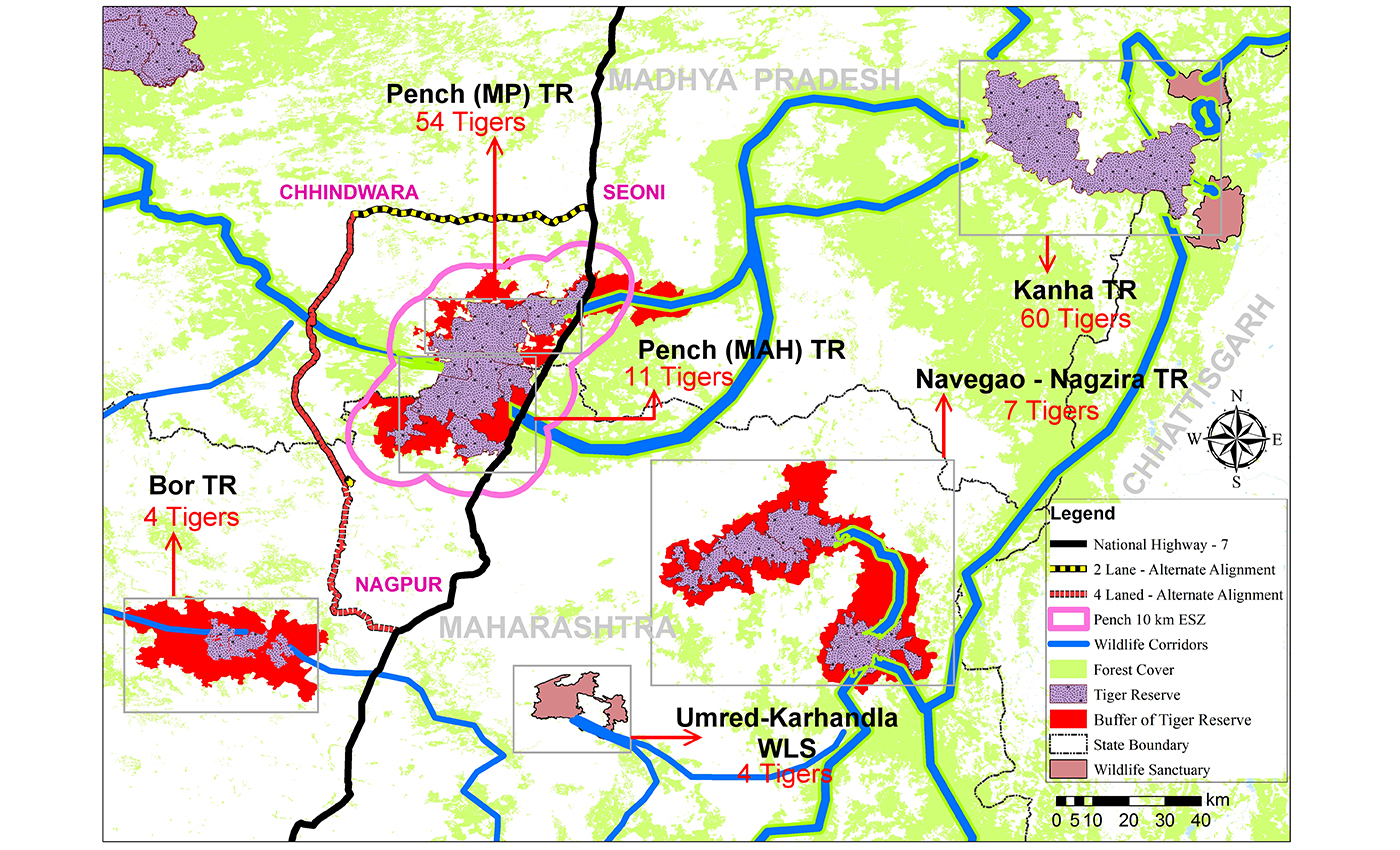
The National Highways Authority of India has been proposing to convert the two-lane road into a four-lane highway much to the chagrin of environmentalists. The road cuts across an important animal corridor between Pench and the Kanha Tiger Reserve in central Madhya Pradesh. The Pench-Kanha forest stretch is on of the few unfragmented tiger corridors left in the country. Tiger tracking and wildlife research has shown that the tiger populations in Pench and Kanha interbreed and have created a larger healthy meta-population in central India.
Widening NH7 to allow more traffic, noise and pollution will ruin this essential tiger corridor, wildlife experts say. As a consequence, the highways authority with inputs from the Wildlife Institute of India has decided to elevate the highway for the major part of its length in the forest. But even if elevated, road expansion will still involve cutting more than 2,000 trees over 49 hectares of forest land.
Bypassing forest clearance
Any development activity on forest land first needs to be cleared by environment ministry of the central government. Such a clearance should normally be granted in five steps. The state government applies to the environment ministry for clearance. Once the ministry has determined that the project is not environmentally detrimental, it gives an in-principle clearance. This first clearance allows the project proponent to meet all other conditions to start work, like obtaining approvals under the Forest Rights Act from the National Board for Wildlife and gram sabhas. Once this is done, the project goes back to the environment ministry for a second stage approval. The last step is for the state government to issue and order under Section 2 of the Forest Act allowing the land to be diverted for non-forest use.
The environment ministry last year issued a circular exempting linear projects like roads and highways from these multiple clearances, allowing them instead to start work once they had got in-principle clearance. The National Green Tribunal stayed the ministry’s order in February.
In 2013, the Nagpur bench of the Bombay High Court took up the matter of the state of NH7 in the Pench Tiger Reserve after a newspaper reported the shoddy conditions of the road saying it was both dangerous and that it caused terrible traffic snarls. The court not only ordered the highways authority to pave the road immediately but also to start work on expanding the road to four-lanes. The Maharashtra government issued a temporary working permission on the basis of which the tree-felling for the road expansion began.
Green tribunal sees red
But an NGO , Shrushti Paryavaran Mandal, petitioned the National Green Tribunal against the expansion, upon which the tribunal decided that work on forest land cannot start until the state government issues a Section 2 order. The tribunal stayed all work and tree-felling in in its orders of May and August, despite which the work has continued.
In the latest hearing of the case, a five-member NGT bench observed that its previous orders have been violated with impunity. The court said that none of its previous orders had been contested in the Supreme Court, which is the only court of appeal for a case heard at the tribunal. The tribunal then asked why Maharashtra’s secretary of forest and environment, chief conservator of forest and chief general manager of the highways authority should not be arrested for such flagrant violations.
Under the threat of drastic action by the tribunal, the Maharashtra government issued the Section 2 order on Wednesday.
However, the Bombay High Court took the matter up again on Thursday and said that the Shrushti Paryavaran Mandal can be held in contempt for petitioning the National Green Tribunal while the matter was being heard at the High Court. The judge was of the view that development must not be stalled on the concerns of environmentalists.
Which road is better?
Behind this procedural tussle is the even bigger question of the road through the reserve and an alternate route around it. In 2009, a central empowered committee considered the NH7 expansion and another road, NH69, that connects Nagpur to Chindwara going far around the western side of Pench. The committee found that the NH69 route was less environmentally detrimental and should be used instead of expanding the road through the Pench-Kanha corridor.
The NHAI rejected the alternate route citing greater financial costs, longer travelling distance by 70 kilometers and more vehicular emission and pollution as a result.
Wildlife scientists designing mitigation measures for project are of the opinion that development along the road is inevitable, with more than 20 growing villages and towns already present along its length. The NH7 expansion involves 700-metre long flyovers, underpass and culverts to allow tigers and other wildlife to pass through. This was cut down from an initial proposal to have a 2-kilometre long flyover, a compromise for cost. The mitigation proposals now are based on techniques used in the United States and Canada. But no one know how these measures will hold up in Indian reserves with Indian fauna including the national animal, the tiger.
You’ve read Scroll.
Now help sustain it
Scroll is funded by readers, not corporate owners. If you believe our work matters, support our newsroom. Become a member today!
We’re not driven by clicks or corporate interests – just honest, independent reporting. Keep us going. Support Scroll today!