Prime Minister Narendra Modi’s penchant for peppering his comments with the sort of thing you might expect from a Whatsapp forward is easily mocked, but it also has immense staying power. Even if you don’t agree with him, it’s hard to argue that the things he said, whether it was calling Congress Vice President Rahul Gandhi “shehzada” or offering up acronym after acronym, ended up becoming household terms (and not just on Twitter).
In contrast, former Prime Minister Manmohan Singh’s most memorable words are probably limited to “theek hai,” and the phrase that’s most associated with all of the United Progressive Alliance second stint is “zero loss”. Neither of those, it’s important to point out, is being used in the ways that the government at the time intended them to be. But then it’s no news to learn that the United Progressive Alliance was bad at communicating ideas.
What is impressive is how good the new government and the larger right wing has been, not just at messaging, but also at using language to define entire agendas. “There is no battle between power and the media,” Robert Fisk once said in a lecture about political semantics. “Through language, we have become them.”
Take reconversions as an example. These are, of course, no different from conversions, since they usually involve the ghar wapsi of people whose families were converted out of Hinduism several generations ago. Each reconversion is mostly just a conversion, yet adding that "re" at the start of the word changes its meaning, suggesting something slightly more benign, more natural. Despite this, a quick search on Google News shows thousands of headlines using the word, often dispensing with the single quotes altogether.
Although reconversions have not yet received official sanction from the government, other than the "Prime Minister expresses dissatisfaction in private" story that seems to be the new version of "Sonia Gandhi expresses dissatisfaction" pieces, the formula has already been experimented earlier this year, with Love Jihad. Taking a term that was actually first used by the Catholic Church in the south, various parts of the Sangh Parivar made a decisions to spread the canard that there is a grand Muslim conspiracy to seduce Hindu women and get them to convert to Islam.
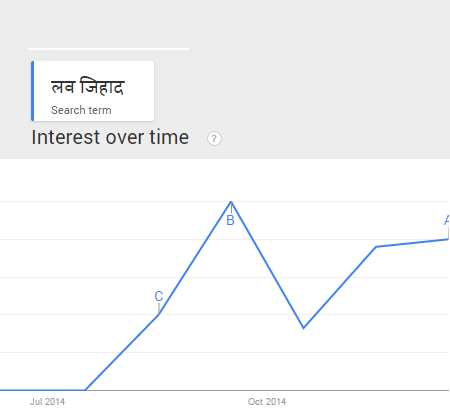
The decision to build a bypoll election campaign on this platform in Uttar Pradesh and Bihar backfired on the Bharatiya Janata Party, but the term has nevertheless entered most households in North India and its presence alone lends it some credibility. While its usage in the English media usually comes with question marks about whether Love Jihad is even a real phenomenon, in the Hindi press it is taken as a given.
The more blatant attempts at inserting phrases and terms into the national discourse also worked very well for Modi's team, although that approach has got them into trouble as well. Acche Din and Ab ki baar, Modi Sarkar, the taglines for the Modi campaign in the run up to the general elections, were impossible to avoid. They became household terms in part because the BJP made an effort to beam them into every single home, via television, newspaper, radio, internet and even the telephone, through robocalls.
But this straightforward attempt at advertising meant that the BJP was also vulnerable to mockery, led of course by internet trolls. The Ab ki baar rhyme scheme was so easy to copy, that it turned into an inexhaustible well of humour, although little of that was directly levelled at the BJP. Acche Din however, as a promise of good times to come, has a harder one for the government to avoid because it can and has been brought up every time something goes wrong.
Indeed, the only serious efforts by the opposition in the past seven months to counter the BJP's smart use of pithy phrases has been to appropriate and subvert, such as the civil society protest under the "Ab ki baar, hamara adhikar" banner. None of those efforts, however, have gone very far.
Other efforts from the government sought to brand initiatives without the previous governments unwieldy appending of former politicians' names to them, so you have Make in India, Swacch Bharat and even the Jan Dhan Yojana, which technically has a Pradhan Mantri attached to it, but is mostly spoken and written about without the PM portion).
As we get to the end of the year, with Christmas being turned into Good Governance Day, it might be a good time to appreciate just how much our vocabulary has been altered by Modi, his team and the Sangh Parivar, and to wonder how many more terms are set to enter our lexicon in 2015.
In contrast, former Prime Minister Manmohan Singh’s most memorable words are probably limited to “theek hai,” and the phrase that’s most associated with all of the United Progressive Alliance second stint is “zero loss”. Neither of those, it’s important to point out, is being used in the ways that the government at the time intended them to be. But then it’s no news to learn that the United Progressive Alliance was bad at communicating ideas.
What is impressive is how good the new government and the larger right wing has been, not just at messaging, but also at using language to define entire agendas. “There is no battle between power and the media,” Robert Fisk once said in a lecture about political semantics. “Through language, we have become them.”
Take reconversions as an example. These are, of course, no different from conversions, since they usually involve the ghar wapsi of people whose families were converted out of Hinduism several generations ago. Each reconversion is mostly just a conversion, yet adding that "re" at the start of the word changes its meaning, suggesting something slightly more benign, more natural. Despite this, a quick search on Google News shows thousands of headlines using the word, often dispensing with the single quotes altogether.
Although reconversions have not yet received official sanction from the government, other than the "Prime Minister expresses dissatisfaction in private" story that seems to be the new version of "Sonia Gandhi expresses dissatisfaction" pieces, the formula has already been experimented earlier this year, with Love Jihad. Taking a term that was actually first used by the Catholic Church in the south, various parts of the Sangh Parivar made a decisions to spread the canard that there is a grand Muslim conspiracy to seduce Hindu women and get them to convert to Islam.
The decision to build a bypoll election campaign on this platform in Uttar Pradesh and Bihar backfired on the Bharatiya Janata Party, but the term has nevertheless entered most households in North India and its presence alone lends it some credibility. While its usage in the English media usually comes with question marks about whether Love Jihad is even a real phenomenon, in the Hindi press it is taken as a given.
The more blatant attempts at inserting phrases and terms into the national discourse also worked very well for Modi's team, although that approach has got them into trouble as well. Acche Din and Ab ki baar, Modi Sarkar, the taglines for the Modi campaign in the run up to the general elections, were impossible to avoid. They became household terms in part because the BJP made an effort to beam them into every single home, via television, newspaper, radio, internet and even the telephone, through robocalls.
But this straightforward attempt at advertising meant that the BJP was also vulnerable to mockery, led of course by internet trolls. The Ab ki baar rhyme scheme was so easy to copy, that it turned into an inexhaustible well of humour, although little of that was directly levelled at the BJP. Acche Din however, as a promise of good times to come, has a harder one for the government to avoid because it can and has been brought up every time something goes wrong.
Indeed, the only serious efforts by the opposition in the past seven months to counter the BJP's smart use of pithy phrases has been to appropriate and subvert, such as the civil society protest under the "Ab ki baar, hamara adhikar" banner. None of those efforts, however, have gone very far.
Then there are always Modi's preferred acronyms and abbreviations. We put together a woefully incomplete list of them, from INCH to MILES (India-China to a Millenium of Exception Synergy. Yes, seriously) to RSVP (Rahul, Sonia, Vadra and Priyanka) here, but the prime minister appears to be adding to these every day.
This sounds like a rather lame metal gig. pic.twitter.com/H4M1b6dGiR via @KabirTaneja
— karachikhatmal (@karachikhatmal) December 15, 2014Other efforts from the government sought to brand initiatives without the previous governments unwieldy appending of former politicians' names to them, so you have Make in India, Swacch Bharat and even the Jan Dhan Yojana, which technically has a Pradhan Mantri attached to it, but is mostly spoken and written about without the PM portion).
As we get to the end of the year, with Christmas being turned into Good Governance Day, it might be a good time to appreciate just how much our vocabulary has been altered by Modi, his team and the Sangh Parivar, and to wonder how many more terms are set to enter our lexicon in 2015.
You’ve read Scroll.
Now help sustain it
Scroll is funded by readers, not corporate owners. If you believe our work matters, support our newsroom. Become a member today!
We’re not driven by clicks or corporate interests – just honest, independent reporting. Keep us going. Support Scroll today!